The year was 1999. I was splitting my time in New York City between my internship at Globo TV as a news production assistant and doing graphic design work, painting, absorbing, and embracing every opportunity in the “Capital of the World”—as the city’s advertising campaign declared at the time, with banners spread all over Manhattan.
That’s when I was commissioned to design the storefront of a restaurant owned by a Brazilian businessman from the nightclub industry. He was very specific in his briefing:
“I want a big face of Carmen Miranda, with that huge mouth and lots of fruit on her head, right across the front of the restaurant.”
Although I had heard stories about Carmen Miranda, the Brazilian woman who made it big in America with her baubles, turbans, and bananas, told by my dear mother, I had never painted her before.
I began researching images of our Pequena Notável (Little Notable) in New York bookstores. I had decided to paint an oil-on-canvas portrait as a study for the project since I would be painting the mural for the restaurant’s façade. But I couldn’t find much. The only item I came across was a small cut-out doll booklet with outfits to dress up.
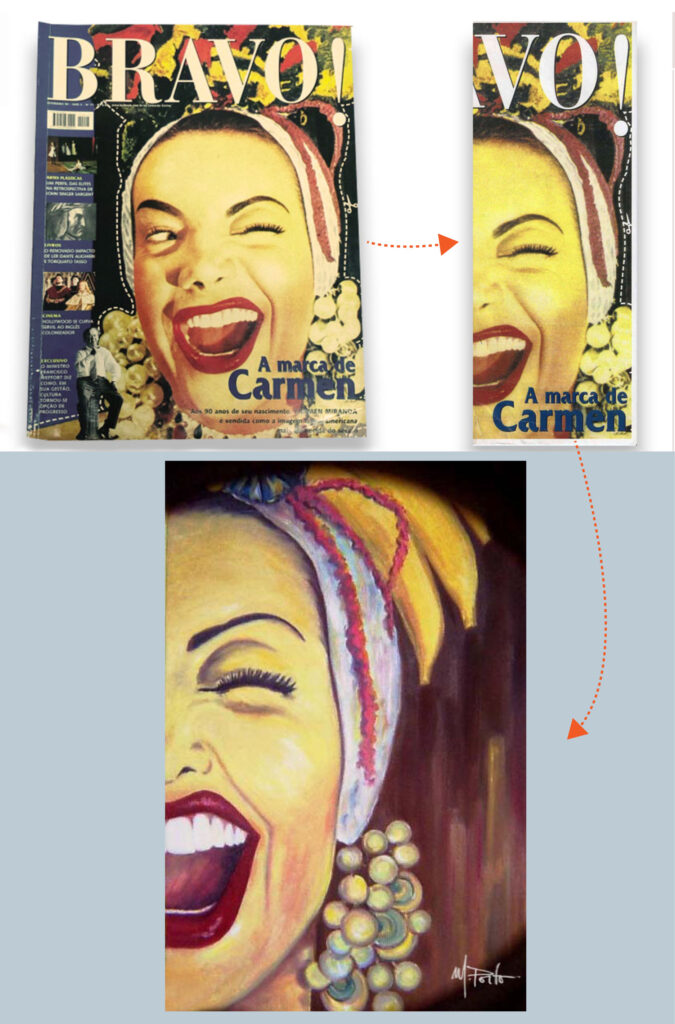
Then, during a visit to my friend and brother-in-law Luís Veronese, who worked for the Brazilian publishing house Editora Abril’s NYC office. I saw on his coffee table an issue of Bravo, an arts magazine, featuring Carmen on the cover.
There she was: a close-up image with a wide, joyful laugh, bright red lipstick, dazzling teeth, and her iconic turban turban decorated with carnival elements. However, she was winking at the camera, which distorted her face – one eye closed, the other misaligned – giving her a somewhat cross-eyed look.
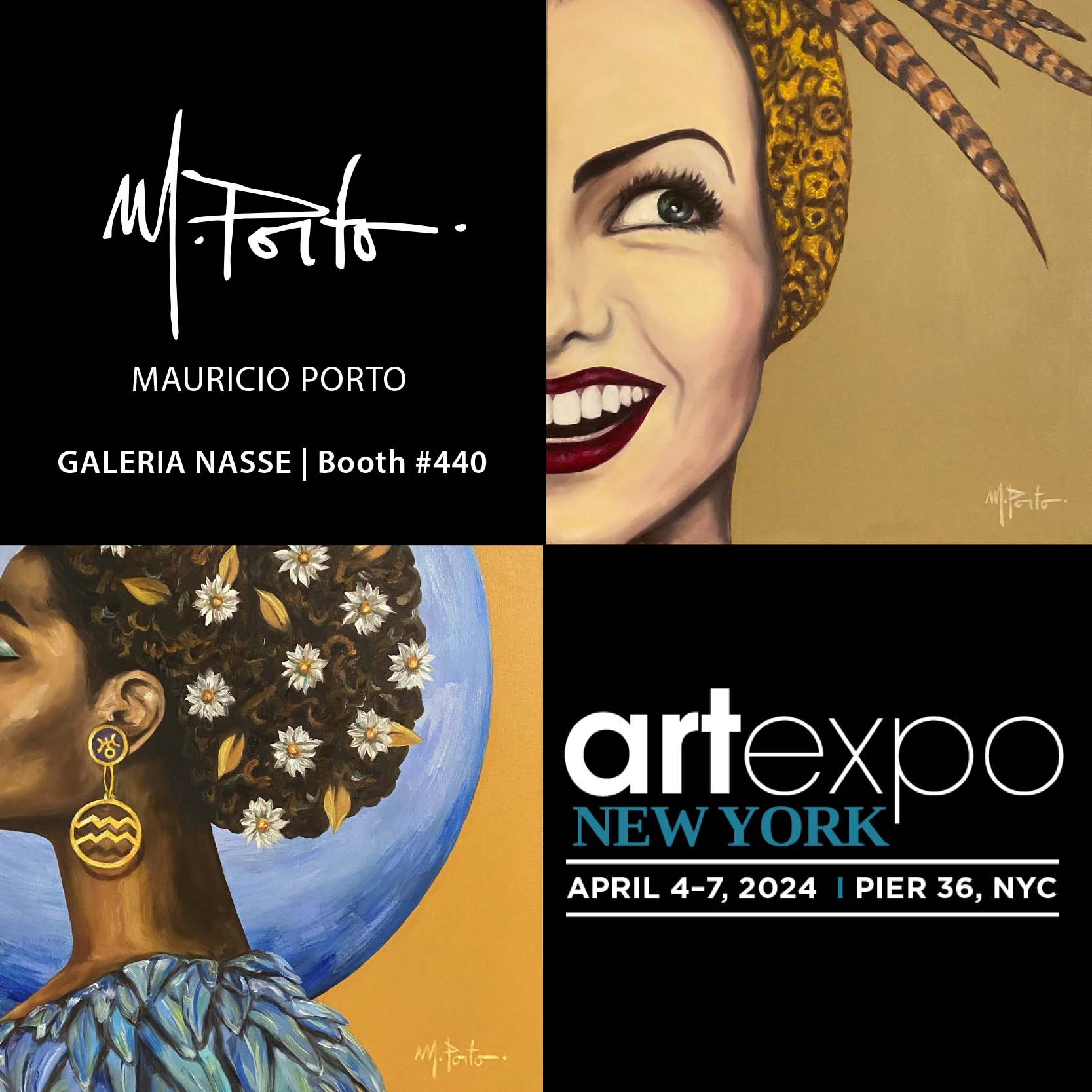
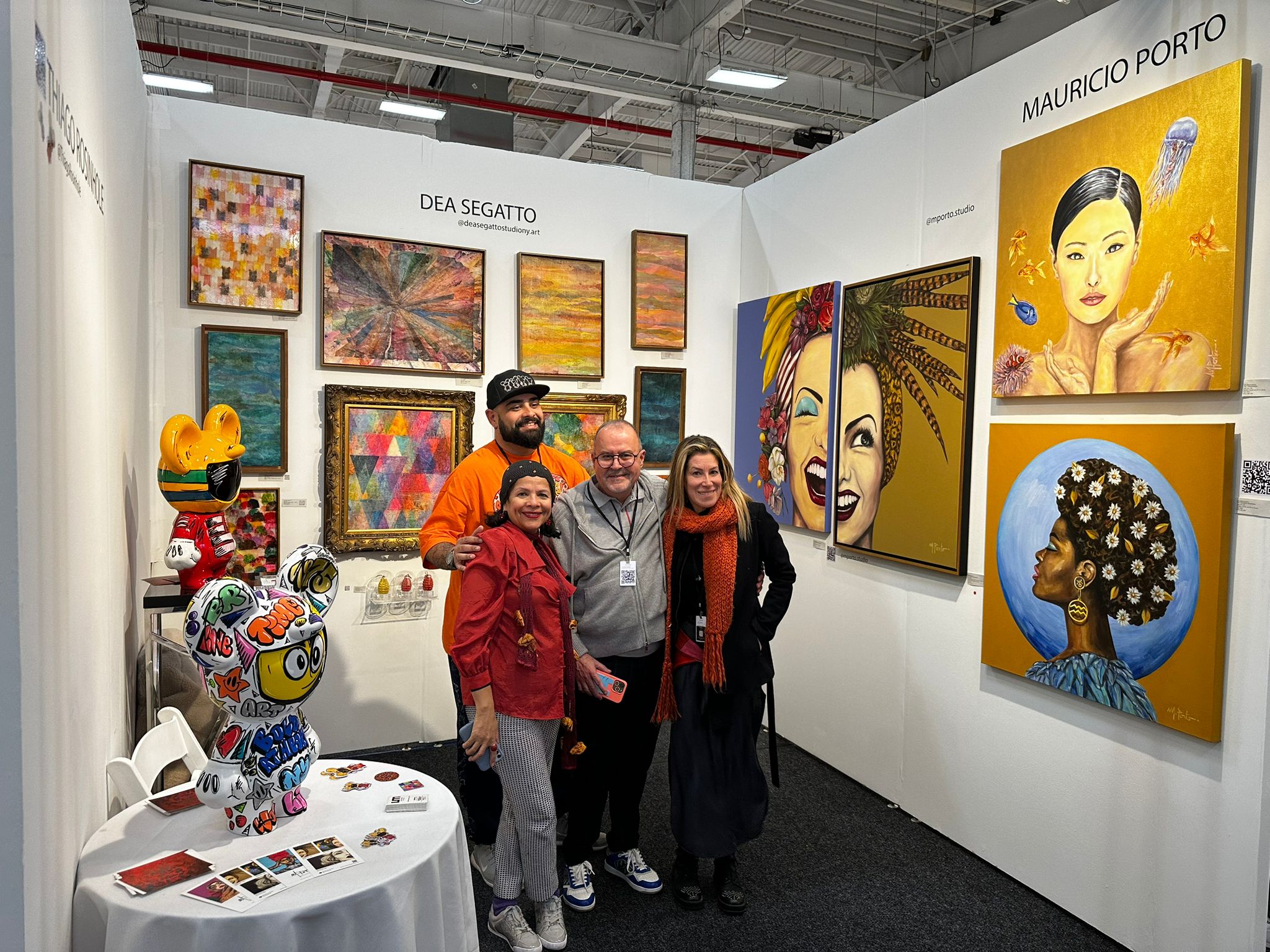
I asked to borrow the magazine, made a color Xerox copy, and brought it home. The first thing I did was fold the image in half to eliminate the open eye – the “off” one – because it wouldn’t translate well into a painting. I was left with just half of her face, the one with the closed eye. But that half held all the magic of Carmen Miranda.
I transferred the image to canvas by sketching in pencil, picked up my brushes, and began painting. That was the beginning of discovering who would become my muse.
The Summer Salon
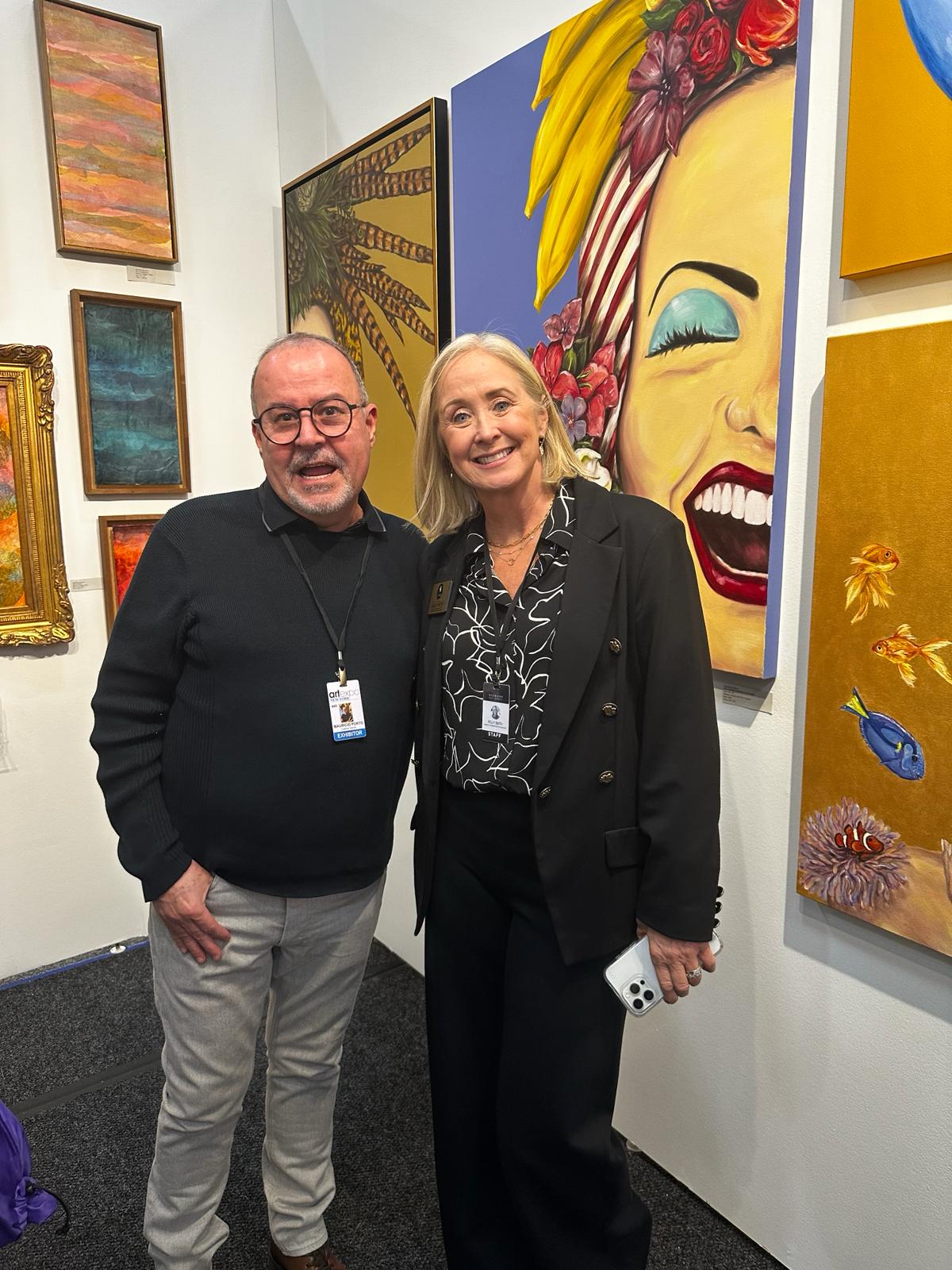
At the time, I embraced every opportunity to show my art. I had an exhibition for a month at Café Del’ Artista, on Greenwich Ave in the West Village. During the show, my husband Jorge Veronese found out about the Summer Salon at Ward-Nasse Gallery on Prince Street in Soho. We went, and I submitted only the Carmen painting – a 30 x 40 inch (76 x 100 cm) canvas. The exhibition lasted through June 1999, but Carmen’s half-face portrait stayed on the wall for less than a week. The gallery called me: the piece had been sold to a young American couple from Albany.
That’s how it all started – more than 40 Carmen Miranda portraits followed. In the end, the restaurant project never happened, but it paved the way for what came next.
The Image
Diving into these half-face portraits of Carmen Miranda, I couldn’t help but dive deeper into her story as well.
My mother had already told me about Carmen’s legacy, including her sudden and early death. But the act of painting her made me want to learn more.
Yes, behind the turbans and beneath the bananas and pineapple crowns lived a brilliant mind and a vibrant personality that dazzled Brazil and helped shape its musical and samba heritage.
Discovered by American producer Lee Schubert, Carmen made her debut on Broadway and quickly became the highest-paid singer-actress in 1940s and ’50s Hollywood – even before she was fluent in English.
Reading Carmen Miranda – A Biography by Ruy Castro, I also learned about the highs and lows of her stardom. The relentless work schedule that led to addiction and periods of depression. Yet, for the public, “The Lady in the Tutti Frutti Hat” was nothing but sparkle and glamour.
She toured Europe and returned to Brazil, where she was sadly met with a cold reception. During a performance at the Casino da Urca – the same stage that had once celebrated her—the press and audience deemed her “too Americanized.” After a “silent boo” from the elite crowd, she left in tears and returned to New York disheartened. As a response, she recorded the samba “Disseram Que Eu Voltei Americanizada” (“They Said I Came Back Americanized”), written especially for her by Luís Peixoto and Vicente Paiva. It became a massive hit.
So much charisma, so much impact. All of this only inspired me more. Painting Carmen Miranda’s portraits became a magical process for me.
In my opinion, Carmen would still fill Broadway theaters today – the very stage from which she launched into the world, earning the title bestowed by the American press: “The Brazilian Bombshell.”
The Coincidence
As I read her story and marveled at the dazzling life and eternal pop legacy she left behind, I came across a curious detail:
Carmen Miranda and I are both Aquarians – almost birthday twins. She was born on February 9, 1909. I was born on February 10.
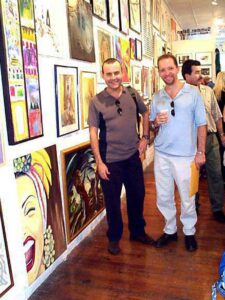
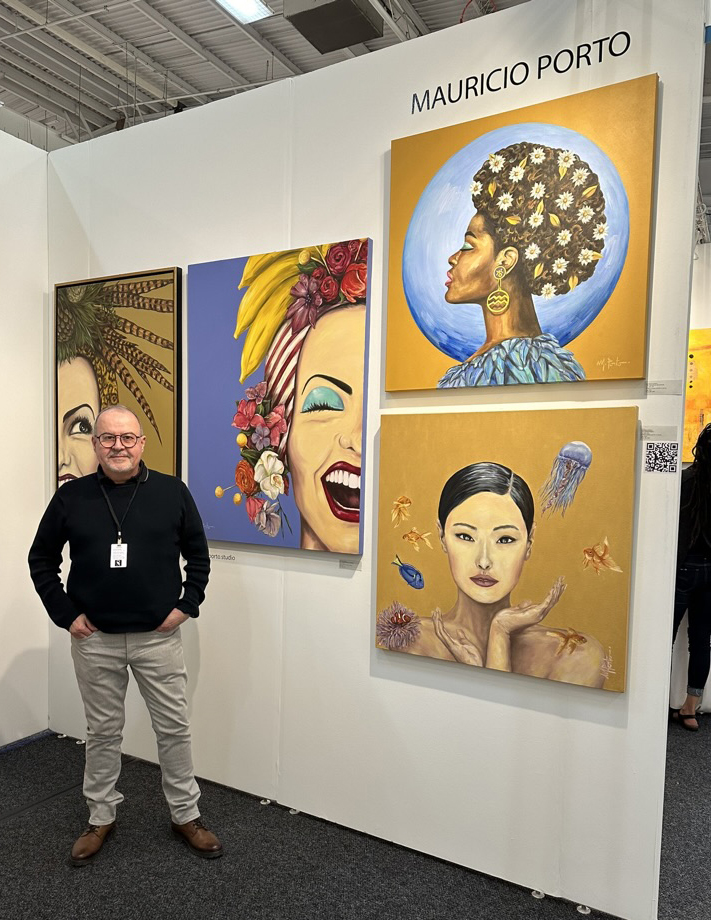
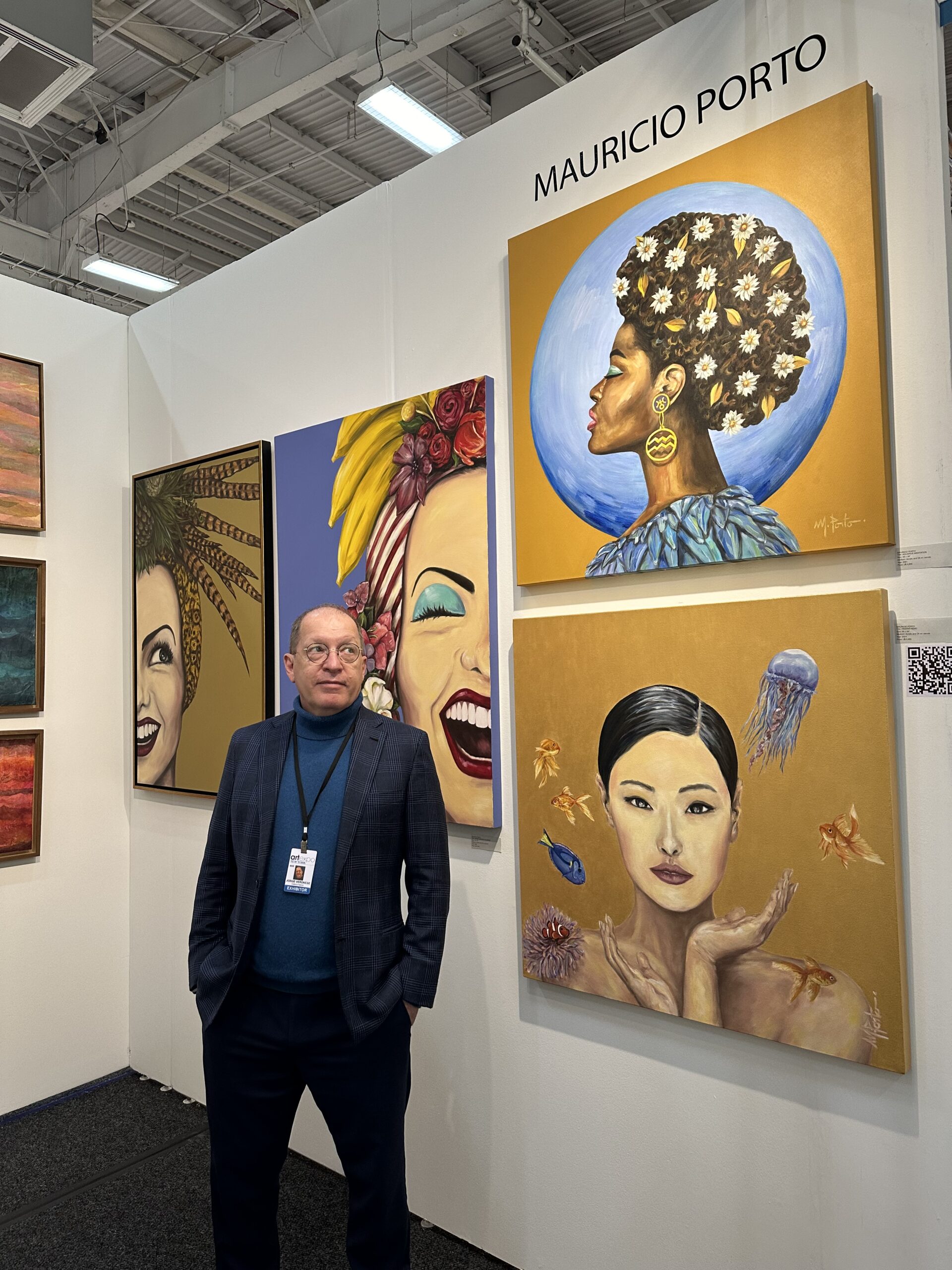
Above: With my husband Jorge Veronese at Ward-Nasse Gallery Summer Salon 1999, Soho, New York.
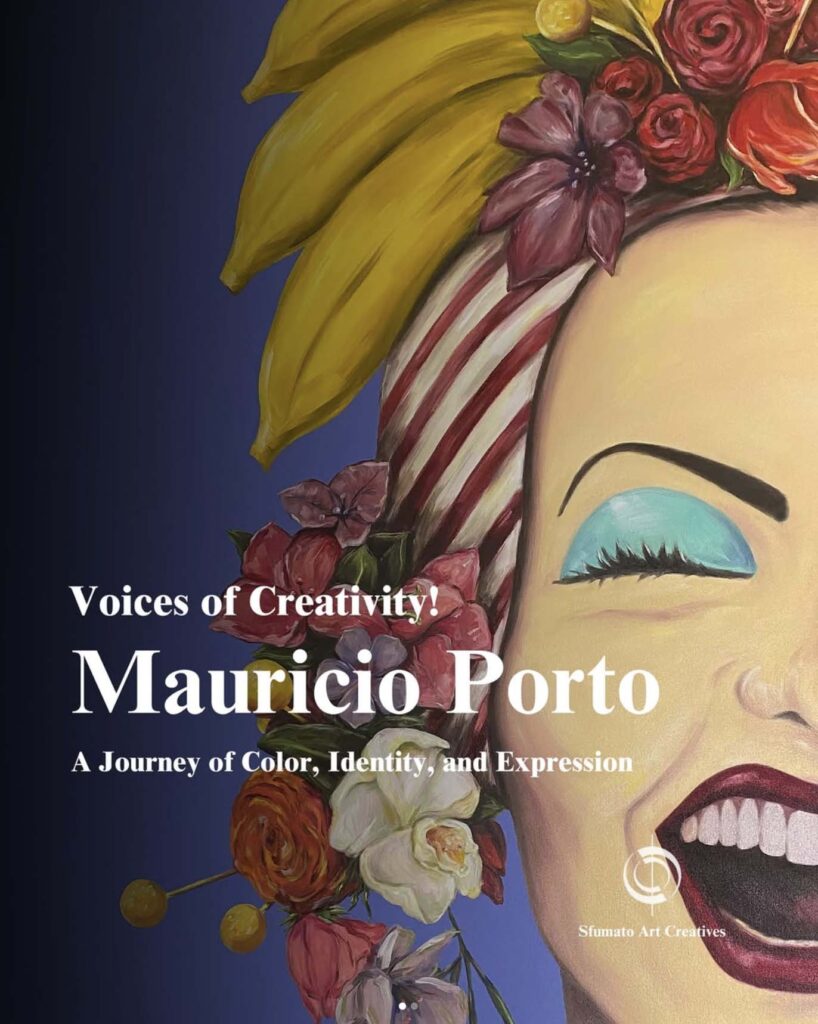
Mauricio Porto’s artistic path is woven with resilience, passion, and a deep-rooted connection to his personal history. From his early childhood in Brazil to his emergence in New York’s vibrant art scene, his journey is marked by perseverance and an unwavering commitment to his craft. Through vivid colors, expressive figures, and a unique stylistic approach, Porto’s work seeks to uplift, inspire, and bring a sense of beauty to the world.
Porto’s love for art began in childhood, nurtured by his mother, who recognized his innate talent. She provided him with colored pencils and notebooks, encouraging his passion for drawing. At the age of 16, she enrolled him in private art lessons with a professional painter in their small Brazilian hometown. It was there that he learned his first brushstrokes in oil, developing a deep appreciation for colors, their harmonies, and even the distinctive smell of paint. Despite his early artistic promise, Porto did not attend art school. His family had no background in the arts; his mother’s side was primarily farmers, while his father’s side was filled with dentists. Though his talent was recognized in small exhibitions alongside his art teacher, there was no encouragement to pursue art as a career. Instead, Porto followed a more conventional path, earning a degree in Social Communication with a focus on Marketing and Advertising. His professional career led him into the advertising world as an art and creative director, but painting remained a constant presence in his life.
At 18, just before starting university, Porto faced one of the most painful moments of his life—losing his mother to suicide. Her passing, following a period of deep depression, left an immeasurable void. Yet, instead of extinguishing his creative spirit, this tragedy deepened his connection to art. His first portrait was of his mother, painted while she was still alive. She had proudly shown it to everyone, celebrating her son’s gift. Even today, she remains a source of inspiration, her beauty and grace continuing to influence Porto’s artistic vision.
Despite the hardships, Porto never abandoned painting. Throughout his years in advertising, he continued taking commissions, expanding his ideas, and nurturing his inspirations. The creative energy of painting provided him with an emotional refuge, allowing him to express what words could not.